
eVTOL versus “eCOPTER”
Hans-Christian Stuber, UASystems SA, Payerne/Switzerland 12. February 2022
In its 2018 paper “The Future of Vertical Mobility”, Porsche Consulting writes that eVTOLs are 4x quieter, have 15x higher reliability, are 2x safer, and are 10x cheaper than helicopters. The Vertical Aerospace homepage states that their VX4 is 100x quieter in cruise and hover than a helicopter. Some statements are certainly correct as far as today’s helicopters are concerned, but no eVTOL can replace a helicopter to date and no eVTOL is yet certified. But who says that in the future helicopters won’t be able to fly electrically? The eRobinson44 is a good example and the above negative statements about helicopters concept will falter. Almost without exception, all eVTOL projects in progress state zero emissions, which is, of course,gratifying.
Most eVTOLs are sluggish in the air, can only fly sideways and backward to a limited extent, the many motors with small propellers generate frequencies that are annoying for the ear, the required gravimetric energy density of the batteries still will take years to leave the labs and enter the market. The technology of tilt-wing or tilt-rotor aircraft is complex and can endanger the safety of the flight, take-off, and landing, especially during the transition in the event of a faulty tilt function. A tilt wing exposed to the wind during landing and take-off by the wings placed in the horizontal position is probably more difficult to control in strong winds, but should always be ready for action like helicopters.
Very few eVTOL designs offer autorotation, a safety advantage of all helicopters also in future with electrical engine. Carrying +/-600kg batteries through the air for 20 minutes flight time can’t be the goal either and there isn’t enough reserve for a “go around” in case of an event on the landing site. Having no reserve to offer will be one of the largest hurdles to overcome during certification and will deny the use over sea, thus a serious limitation to versatility. Battery charging cycles of the current state-ofthe-art batteries are still too low and the batteries are heavy and expensive. Lightweight and preferably low- or zero-emission generators/range extenders are a need, but hard to find/non-existent. Another problem in some environments could be the cold. In a test report from Norway, where all existing electric cars were tested in temperatures as low as -10 degrees Celsius, battery performance dropped by an
average of 20%.
While reading business plans from eVTOL developers and plenty of articles about eVTOL, for AAM (Advanced Air Mobility) and UAM (Urban Air Mobility) the helicopter is written off. They want to oust helicopters for these two markets with big potential. Wrongly? Facing obvious technical limitations in an attempt to reinvent the wheel yet ignoring a solution that proved its safety and versatility for almost a century, indispensable and without alternatives for military and civilian and private operators seems like wishful thinking. It is the difference between a proclaimed, uncertain revolution that asks for compromises and the evolution of a system that is well known and already close to perfection.
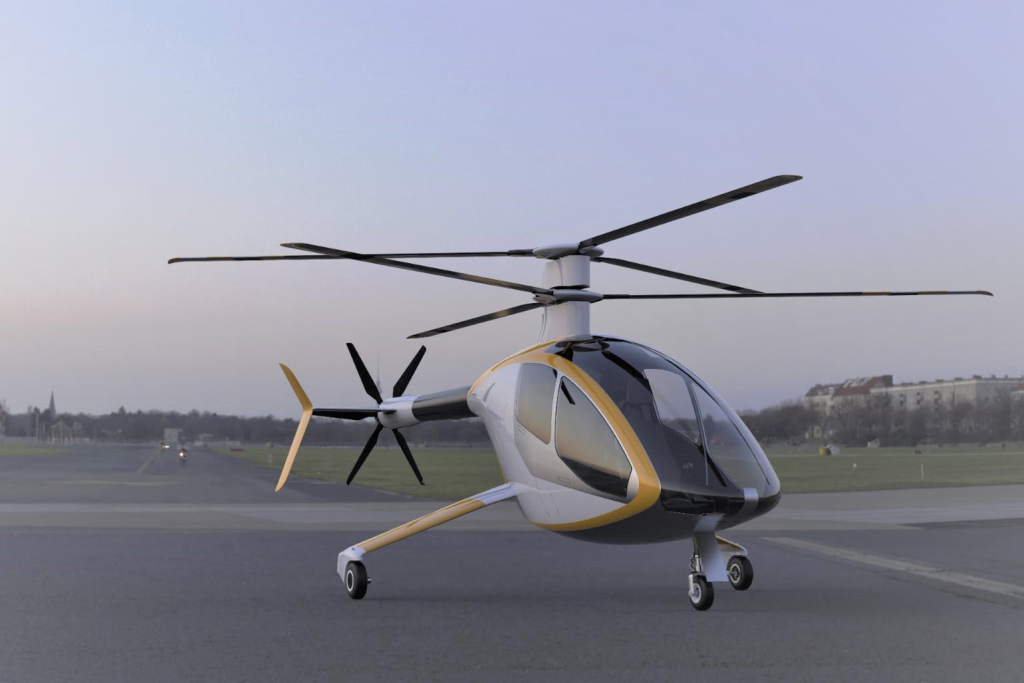
With the eZELOS (eVTOL) we stick to the coaxial compound system, “I’m a helicopter” and the use of a generator/range extender. The skills in flight, during takeoff, and landing, even in strong winds, is practically unbeaten and the eZELOS offers autorotation. Through the compound design with a pusher propeller, the eZELOS will act and perform as an autogyro during a cruise flight. Through the gyro effect, the required power to hold the flight level will decrease significantly, further increasing flight stability, as well as enabling higher top speeds. As a safety measure, the pusher propeller is only active in the air or as support for take-off and landing during very strong headwinds. Both eVTOL and eSTOL are possibilities (eSTOL will save energy when a short runway is available). No noise from the tail rotor, (tail rotor not
needed on coaxial helicopters), avoid the noise from cutting the downwash through the tail rotor and much less noise through the electrical engine as our close partner Pascal Chrétien has proved with his manned electrical coaxial helicopter (Guinness Book of World Records). Quicker mandatory pre-flight check through simple propulsion system instead of several engines and tipping mechanisms. Trust from
passengers in helicopters!
Another advantage is the feature that makes the fuselage independent of the lifting system dynamics permits the design of the fuselage to be strictly functional as related to requirements. Accordingly, the size of the coaxial rotor system fuselage for the same useful load is smaller than any other type and structurally simpler, resulting in lower fuselage weight.
Since paper is patient, similar to our competitors we have to prove our claims, and this can only be done with the eZELOS in the air. We are therefore developing a 1:1 prototype and hope to be able to hold various demonstrations before the end of 2022 or early 2023, to which you are cordially invited. eZELOS belongs to the eVTOL community because he also has an electric drive and vertical starts and landing
capacities . . . and much more!
eZELOS Highlights
• Coaxial (eVTOL & eSTOL)
• High-Speed up to 250km/h
• Autorotation
• Compound – Pusher propeller (Gyro-Effect)
• Low noise level
• Very stable and agile even in strong wind
• Less mechanical parts than others
• Low operating costs
• Long endurance (Generator/Range Extender
• Aerodynamic frame
• Two passengers one pilot (Air-Taxi)
• Future (rules); Three passengers (autonomously)
• Air-Cargo & Air-Ambulance
• Private market