
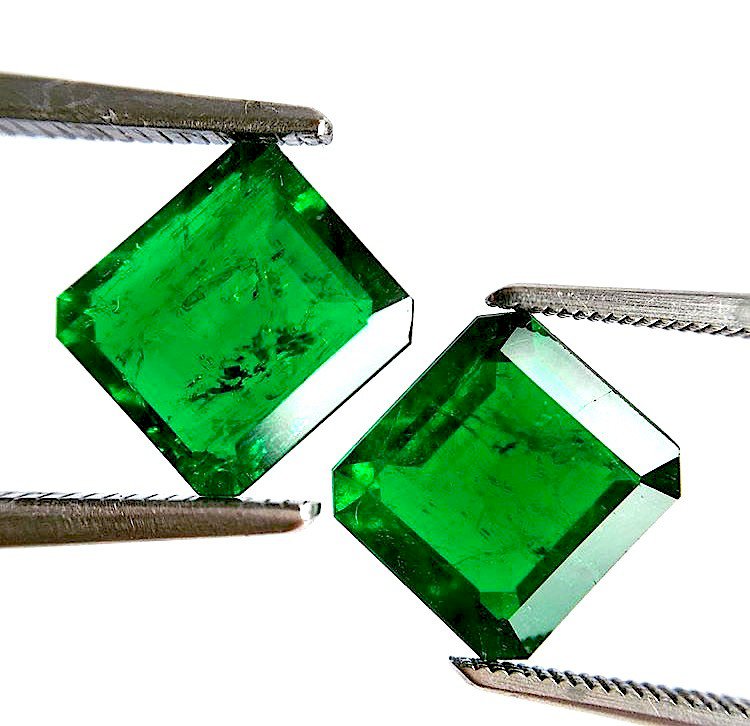
Most cut emeralds undergo some treatment
The refining process and its impact on prices.
It is human nature to strive for excellence, and this aspiration extends far beyond self-image. We strive to refine virtually everything created by Mother Nature, everything that is beautiful in its own natural form – including gemstones.
The richer the color and the purer the mineral, the better, and that epithet holds true for any gemstone.
So, in search of owning the treasures of nature, which can reap great financial rewards, people began thousands of years ago to refine emeralds in a very simple way: lubrication. And to this day oil treatment is still the most common method used to improve the appearance of emeralds.
Of all the clear gem quality crystals mined around the world, on every continent, there are very few “gem quality” emeralds.
In fact, the highest quality beryl green stones are graced with complex internal crystalline structures known as “garden-like” inclusions.
Despite the fact that a stone with attractive defects is occasionally valued at values no less than its defect-free counterparts with its thick and smooth color, we nevertheless try to correct the natural “errors” in the defective stone by doing what we seems to be unattractive a little less noticeable. This is achieved by filling emeralds along possible fault lines with cedar oil or natural resin, known as “Canadian balm”.
“Since Ancient Egypt, the fracture process filling this wonderful gemstone has been documented in scrolls and other ancient texts. Typically, the preferred method of enhancing the clarity of an emerald is to fill natural cracks and fractures with natural cedar oil or Canadian balm, although other more permanent methods exist.
Unlike the treatment applied to sapphires and rubies, most ways to improve the aesthetic appearance of an emerald are reversible. So if emeralds in oil is just a temporary solution, why is it still the most common treatment?
As this viscous liquid has the unique property of being able to penetrate even the smallest cracks and imperfections and it does so crucially because of its (almost identical) refractive index. The natural oil becomes like a kind of glue, displacing air from the cracks, dissolving debris and cementing the crystals apart.

“The levels or degrees of treatment are set by the LMHC (Lapidary Manual Harmonization Committee) and divided into categories: no oil / insignificant and then minor, moderate and significant treatment.
Stones in the first (secondary) category usually require a small amount of oil to make them reach their full potential. It may be that only a surface reaching the crack has been filled.
The next moderate level of treatment includes stones with multiple cracks reaching the surface, one or more of which will be located on the emerald table. And the last category is composed of rocks with several oil-filled fractures, many of which reach the surface.
The emerald green jewelry in the windows of Van Cleef & Arpels, Chopard, Boucheron, Cartier and other top brands will almost certainly have little to no treatment. Over the years, gemologists at leading jewelry stores have sought out stones for their collections and have never compromised on the quality of the jewelry. For premium jewelry, you will have to pay the price; so if you’re looking for more affordable emeralds, reach out to mid-sized boutiques or lesser-known brands. They often work with emeralds refined to a moderate degree.
Despite the fact that oiled emeralds make them more visually appealing, their value suffers. “Using a 3 carat stone of great color and clarity as an example, with all things but the level of treatment being equal, we can explore the effect this has on an emerald’s value.
Emeralds with no clarity enhancement indication that do not require fracture filling to improve appearance demand huge premiums over their counterparts. If a stone is rated as exhibiting ‘minor’ indications of clarity enhancement, prices can range from $12,000 to $18,000 per carat.
If it belongs to the “moderate” category, the value ranges from $8,000 to $12,000 per carat. Finally, an emerald displaying “significant” indications of treatment can be worth anywhere from $4,000 to $6,000 per carat.
These prices are just a rough guide as there are a number of other factors that affect prices,” explains George. If you do manage to find an all-natural emerald, be prepared to pay a hefty price for it: these stones are so rare that Smith reckons they constitute a mere 0.5% of the market.
And finally, certificates are also worth talking about, because they are your guarantee of quality. The most reputable and reliable are the two Swiss laboratories, Gubelin and SSEF, which carry out the inspection, analysis and certification of most good quality Colombian emeralds on the market (including many emeralds supplied by IEEX). However, they do not indicate in the certificate what kind of refining process was implemented, paying attention only to the degree of improvement undergone by the emeralds.
“They refuse to specify the exact type of treatment agent not because it is not possible to identify it, but because these laboratories only state in writing what they can say with 100% accuracy. The lack of a crack treated with a different filler material can jeopardize the laboratories’ reputation. SSEF is the only Swiss laboratory that provides any indication of the type of treatment, classifying it as “traditional” or “modern””,
This is usually done prior to the cutting process to ensure that any rough stones (which would normally have many fractures and are therefore structurally weak) are able to survive the pressure of the cutting and polishing wheel. For this reason, IEEX employs an oil-only policy, working only with good quality products. Any reputable dealer should disclose the exact type of treatment an emerald may haveundergone.
To summarize, cedarwood oil is 100% natural and as such is the most traditional and favored way of treating an emerald. Normally, a stone with a minimal amount of treatment should never require lubrication, but in recent years many dealers have started using artificial hardened resins (which are essentially synthetic ‘glue’ substance) to fracture emeralds in hopes of providing a more permanent look. treatment for stones that require a lot.